在電動汽車的新大陸上,有一場爭論的硝煙從未散去——到底哪種電機是最好的��?
對此,Equipmake的經(jīng)營主管�、創(chuàng)新型電力傳動系統(tǒng)設計研發(fā)專家Ian Foley表示�����,“這就像80年代早期的計算機之爭����。直到IBM的PC成為業(yè)界標準,這場爭論才得以平息?�,F(xiàn)在我們有各種類型的電機�����,不同的電機的制造理念也不一樣��。我們不應只著眼于電機�,而是要考察包括電機�、電池�、逆變器�����、齒輪箱和控制器在內(nèi)的整體系統(tǒng)解決方案����。最后�,哪個解決方案成本最低,哪個就是贏家���。”
Foley希望�����,最后的勝利屬于自己公司的APM200輪輻電機。他表示���,APM200效率卓越�����,是目前扭矩和功率密度(kW/kg)最高的電動汽車永磁電機,而且它還有成本低��、重量輕等優(yōu)點。
APM200電機的重量約為49kg (108 lb)���,最高轉(zhuǎn)速為10,000rpm����,最大功率和最大扭矩分別為220kW(295 hp) and 450 N·m (332 lb·ft)�,采用了成本更低的釹鐵硼磁鐵(NdFeB)���,降低了電機整體造價,并搭載了5.5:1整體行星齒輪箱�����,齒輪箱的輸出軸和輪轂直接相連���。此外,Equipmake還為APM200研發(fā)了專用逆變器�,采用了結(jié)合碳化硅二極管和IGBT(絕緣柵雙極晶體管)的動力電子技術(shù)�����,使得電機能在高變頻下保持大功率運轉(zhuǎn)。
一冷再冷
冷卻是決定電機性能的關(guān)鍵。電機磁鐵的溫度越低����,電機輸出峰值功率的時間就越長。但是����,光做到冷卻還不夠����,必須要保證冷卻的成本適中���、質(zhì)量可靠����、量產(chǎn)效率高�����。
Foley表示�����,“輪輻電機的結(jié)構(gòu)能夠滿足以上這些要求��。傳統(tǒng)的永磁電機的磁鐵呈V型�����,被壓在轉(zhuǎn)子四周的壓片上,壓入深度很淺�����,而輪輻電機的磁鐵則像輻條一樣垂直于鋁制轉(zhuǎn)子的表面����,使得磁鐵得以非常接近冷卻液(60℃水/乙二醇)��。換言之��,傳統(tǒng)電機的磁鐵是分布在壓片上����,所以無法接近冷卻液;而輪輻電機磁鐵的一端是在鋁制中心轂上�����,所以我們可以讓冷卻液足夠靠近磁鐵,達到散熱的目的��。盡管和傳統(tǒng)電機相比�����,輪輻電機的生產(chǎn)難度更高����,但是我們設計的電機已經(jīng)可以量產(chǎn),對此我們很有信心����。”
Foley表示��,實現(xiàn)電機量產(chǎn)的關(guān)鍵在于落實設計細節(jié)��,比如找到將壓片安裝在中心轂上的方法����,“中心轂基本上是鍛造件���。我們的冷卻非常高效�,所以能獲得所需的高強度����。鋁制中心轂的溫度控制在100℃以下��,因此我們可以使用成本低但性能�、可靠性���、壽命都毫不遜色的磁鐵�。熱能工程是讓一款電動汽車電機脫穎而出的一大關(guān)鍵����。”
據(jù)Foley介紹�,雖然輪輻結(jié)構(gòu)在汽車行業(yè)的知名度還不高,但事實上其拓撲結(jié)構(gòu)早已廣為人知�����。Equipmake輪輻電機的結(jié)構(gòu)還要追溯到公司此前參加的一個名為“HIPERCAR”(高性能減碳)的英國研究項目����,一同參與的還有Delta Motorsport公司和Ariel公司����,項目的目標是在2020年前推出量產(chǎn)超高性能減排跑車��。正是這個項目催生了被Foley稱為“目前扭矩密度最高”的Equipmake輪輻電機��,F(xiàn)oley還表示,“該款電機的性能已經(jīng)得到了充分驗證���,未來還會繼續(xù)改進��。”
APM200輪輻電機的研發(fā)耗時大約三年���,F(xiàn)oley說,“我們成功解決了設計����、冷卻和制造的挑戰(zhàn)。除了HIPERCAR項目之外��,我們和一家阿根廷公司合作開展的客車應用項目也采用了APM200����。我們在每輛客車上搭載了兩臺APM200電機�����、賽米控的SKA1逆變器和AESC電池���。我們的目標是電機的年產(chǎn)量在2020年前能達到2,000臺,然后再節(jié)節(jié)攀升���。”
Equipmake的輪輻電機采用了鋁制中心轂和鋼鐵壓片,鋁具有抗疲勞�、經(jīng)久耐用的性能優(yōu)點,滿足了產(chǎn)品使用壽命的要求��。
至于電機定子,據(jù)介紹����,APM200采用了“非常傳統(tǒng)”的定子��。目前�����,相關(guān)方正在對APM200進行驗證�����,其中包括了使用壽命測試�����。
三句不離成本
Foley很清楚成本對汽車技術(shù)創(chuàng)新的重要性�,“汽車行業(yè)說來說去還是成本的問題。往往工程師提出一些非常好的想法���,但無奈執(zhí)行成本太高�����,這我太了解了��。所以我們想要設計出能最充分地利用磁鐵的電機架構(gòu)���。我們用某家大型整車廠設計的EV傳統(tǒng)電機就輻條技術(shù)進行了比較,結(jié)果發(fā)現(xiàn)��,我們可以在減少25%磁鐵數(shù)目(即降低25%成本)的情況下����,輸出相同的扭矩。”
Foley表示����,如果能有效保持電機的冷卻,就能降低成本���,所以APM200輪輻電機采用了“烹飪級”磁鐵�,“我們的電機工作溫度只有100℃左右�,所以沒有必要使用最高工作溫度為200℃的稀土銣磁鐵。”
至于Equipmake輪輻電機具體可以增加多少續(xù)航里程����,F(xiàn)oley目前還沒有透露任何參數(shù)�。
奔馳的飛輪
多年來����,F(xiàn)oley在工程和技術(shù)創(chuàng)新領域已經(jīng)積累了非常豐富的經(jīng)驗。他的職業(yè)生涯開始于80年代��,最早是在F1車隊任職����,期間研發(fā)了蓮花F1主動懸掛系統(tǒng),并加入了蓮花GT耐力賽團隊��。90年代后期�����,他創(chuàng)立了Equipmake�,公司早期生產(chǎn)過撥片式齒輪箱,許多勒芒賽的賽車都采用了該款齒輪箱�����。
2000年后,F(xiàn)oley開始研究一種新型高速電驅(qū)飛輪�����,后來這款飛輪被威廉姆斯車隊的KERS(動能回收系統(tǒng))采用��。除了F1以外�,這項技術(shù)在很多其它領域也得到了應用����,并由此催生了一家新公司——WilliamsHybrid Power (威廉姆斯混合動力),F(xiàn)oley擔任了該公司的經(jīng)營主管�。
Williams Hybrid Power公司主要是研發(fā)客車�、火車等商用車的電動傳動系統(tǒng)。后來��,這家公司被GKN(吉凱恩)收購�����。
There is a subdued hum in the emerging world of the EV: the sound of several types of electric motor vying for top podium position within the industry.
“It is similar to the computer debate in the early 1980s before the IBM PC became the industry standard,” said Ian Foley, Managing Director of Equipmake, a specialist in the design and development of innovative electric powertrains. “Now, we have many different electric motor types, and they come with different manufacturing philosophies. It is essential to look at the whole system—motor, battery, inverter, gearbox and controls—not just motors in isolation. The lowest cost solution for all of this will win!”
And that, he hopes, will be his company’s spoke motor, designated APM200. He claims that it has already demonstrated such a high level of efficiency that it is the most torque and power dense (kW per kg) of any other types of permanent magnet motors for EVs. It also saves cost and weight, adds Foley.
The motor weighs about 49 kg (108 lb), can run at 10,000rpm, and has peak power and torque respectively of 220 kW (295 hp) and 450 N·m (332 lb·ft). Cost saving is helped by using cheaper grade neodymium iron boron (NdFeB) magnets. The motor incorporates an integral 5.5:1 epicyclic gearbox so the output shaft of the gearbox can be connected directly to the wheel hub. Equipmake also has developed an inverter specific to the APM200. It incorporates Power Electronic technology with silicon carbide diodes combined with IGBTs (Insulated Gate Bipolar Transistors) to improve power capability and allow it to run at high switching frequencies.
Keep cool, keep cool
Cooling is key to electric motor performance; the cooler its magnets, the longer it can run at maximum power. But a must is to do that at the right price and fulfil required reliability and efficient manufacturing criteria.
“Those criteria can be achieved by the spoke configuration,” explains Foley. “A conventional interior permanent magnet motor has its magnets arranged in a very shallow V shape in laminations round the circumference of the rotor; the spoke has them arranged perpendicularly like the spokes of a wheel on the surface of the aluminum rotor, enabling us to get coolants (water/glycol at 60deg C) very close to the magnets. That is not possible in a conventional configuration, which has the magnets sitting in the lamination. Because one end of the magnet is positioned in an aluminum hub, we can get a coolant path very close to it and so conduct out heat. A spoke motor is not as straightforward to manufacture as a regular design but we are confident that we have come up with a usable production version.”
Foley said the key to achieving a solution to meet volume production lay in the spoke motor’s detail design, including the way laminations fit into the hub: “Basically it is a forging that is machined during production. The fact that we can cool it so effectively means we can get the great strength needed. By keeping the aluminum below 100o C, we can use cheaper magnets, with no loss of performance, reliability or longevity. Thermal engineering is one big differentiator between types of EV motors.”
Spoke is a known topology, albeit not in the auto industry, explains Foley. But Equipmake’s involvement with the UK extreme-performance HIPERCAR (High Performance Carbon Reduction) project scheduled for production by Ariel in 2020 (in partnership with Delta Motorsport) generated research that led to the development of the spoke configuration and what Foley describes as “the most torque dense motor, which has been proven fundamentally and is leading to further development."
Its evolution has taken around three years, he said: “Design, cooling and manufacturing challenges had to be overcome. We have done that, not only for HIPERCAR but also for a bus application, working with an Argentian partner using two APM200 motors. The bus project mates the motors with Semikron SKA1 inverters and AESC batteries. We expect to produce about 2000 motors a year by 2020 and ramp up from there.”
Equipmake’s spoke motor benefits from using aluminum for the hub with steel laminations because the material’s properties, notably fatigue and life, are known and able to provide the design life requirements.
The APM 200’s stator is described as “completely conventional." A validation program which includes life testing is now under way.
All about cost
Foley is very well aware of the financial aspect of fresh to automotive technologies: “Everything in the auto industry is about cost; I know very well that engineers are very good at dreaming up great ideas that sometimes cost too much! But having the architecture that gets the most out of the magnets is what matters. We carried out an analytical comparison of spoke technology with a major OEM’s EV conventional rotor and found we could get the same torque with 25% fewer (and cheaper) magnets.”
The spoke motor incorporates what Foley calls “cooking grade” magnets because keeping the temperature of the motor down also brings down costs: “It is not necessary to use rare earth neodymium magnets that work at up to 200o C; we are operating at half that.”
He has not released any specific figures for the Equipmake spoke motor with regard to its contribution to increased vehicle range.
Learning from flywheels, racing
Foley is a highly-experienced engineer and technology innovator. He spent the early part of his career (1980s and 90s) with a variety of F1 teams, working with Lotus F1 on active suspension for several years and was involved with Lotus’ GT endurance team. He formed Equipmake in the late 1990s and one of its first projects was the production of a paddleshift gearbox used at Le Mans by many competing cars.
In the 2000s he began work on a new type of high-speed electric flywheel, which found success in 2009 with Williams F1 in its Kinetic Energy Recovery System (KERS). The technology had many applications beyond F1. As a result, a new company was formed, Williams Hybrid Power, of which Foley was managing director.
Williams Hybrid Power developed electric powertrains for commercial vehicles including buses and trains and subsequently was bought by GKN.
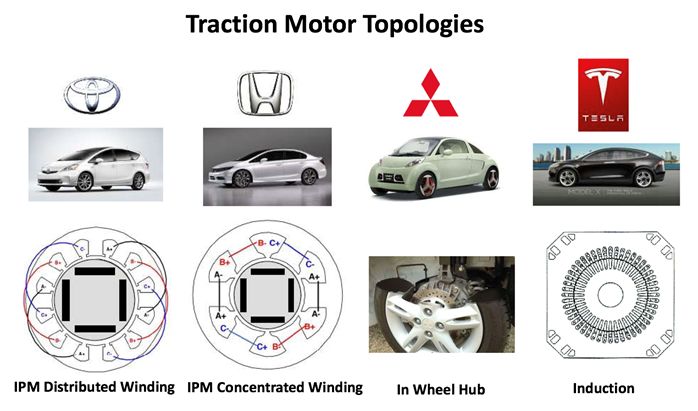 電力牽引電機的拓撲 (Equipmake)
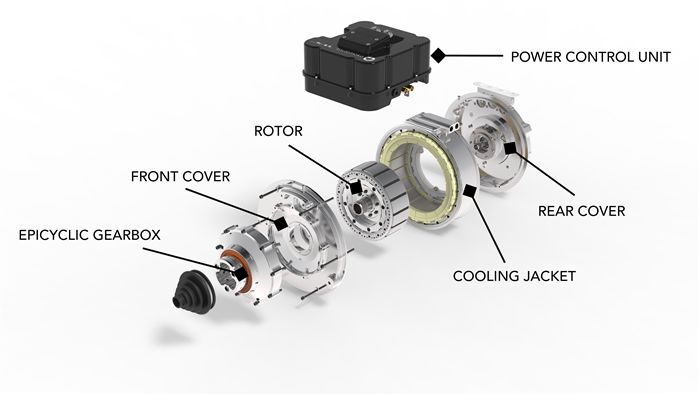 輪輻電機系統(tǒng)剖析圖(Equipmake)
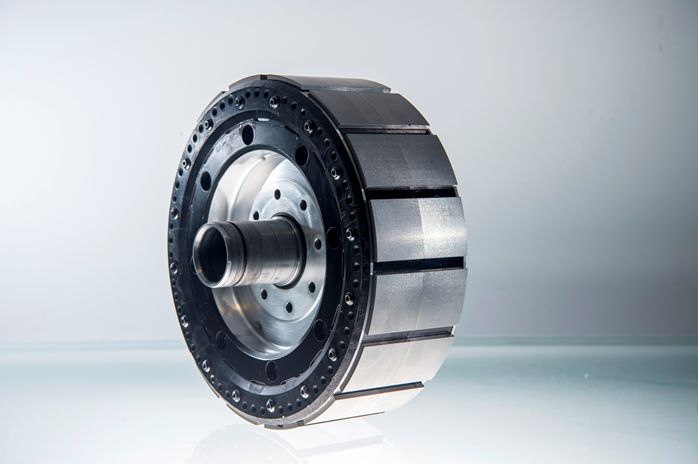 Equipmake APM 200型輪輻電機,最大功率達220kW(295 hp),最高轉(zhuǎn)速10,000rpm (Equipmake)