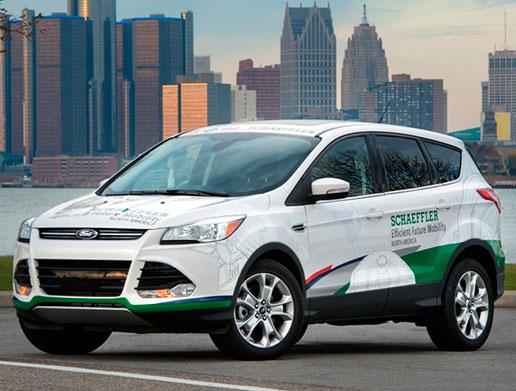
舍弗勒北美未來(lái)高效車(chē)型的測(cè)試車(chē)展示���,通過(guò)運(yùn)用該公司多項(xiàng)成熟的技術(shù)�����,獲得了顯著的CO2減排效果����。
技術(shù)專(zhuān)業(yè)人員運(yùn)用舍弗勒的技術(shù)改進(jìn)了MY2013福特翼虎(Escape)��,改進(jìn)款SUV與原款相比����,在相同情況下,燃油經(jīng)濟(jì)性達(dá)到了兩位數(shù)的提升���。
在2014年1月13日的底特律北美車(chē)展上����,舍弗勒集團(tuán)北美區(qū)副總裁兼首席技術(shù)官Jeff Hemphill告訴《汽車(chē)工程》的記者說(shuō):“我們?cè)诘谝浑A段目標(biāo)是達(dá)到:每一個(gè)燃油經(jīng)濟(jì)性的百分比提升,其成本控制在40美元以下���,同時(shí)滿(mǎn)足2020企業(yè)平均燃料經(jīng)濟(jì)性(CAFE)法規(guī)要求�����。而現(xiàn)在我們幾乎完全符合最初模擬時(shí)作出的推測(cè)�����,節(jié)省了超過(guò)15%的燃油。”
Hemphill介紹道���,舍弗勒的這款SUV測(cè)試車(chē)自2013年9月就開(kāi)始進(jìn)行實(shí)地道路測(cè)試���,經(jīng)過(guò)長(zhǎng)時(shí)間的測(cè)試獲得的結(jié)果是燃油經(jīng)濟(jì)性得到15%以上的提升,而CO2排放量也相應(yīng)減少了近15%�,這一結(jié)果獲得了美國(guó)俄亥俄州一家獨(dú)立測(cè)試機(jī)構(gòu)的核實(shí)確認(rèn)。
該款四驅(qū)SUV測(cè)試車(chē)(被認(rèn)為是“北美未來(lái)的高效車(chē)型”)配有2.0L 4缸EcoBoost發(fā)動(dòng)機(jī)��,加上6速自動(dòng)變速器���,同時(shí)汽車(chē)皮帶傳動(dòng)��、氣門(mén)機(jī)件和平衡軸進(jìn)行了減少摩擦的調(diào)整設(shè)計(jì)����,并配有低滾動(dòng)阻力輪胎以及其他燃油節(jié)省技術(shù)。
熱量管理模塊則與奧迪某些車(chē)型和使用的舍弗勒組件類(lèi)似�����,使測(cè)試車(chē)很快就達(dá)到了最佳發(fā)動(dòng)機(jī)溫度��。該模塊還為其他集成組件提供精確控制的溫度平衡���,在城市道路及高速公路工況下駕駛可以節(jié)省1%的燃油���。
根據(jù)不同的駕駛工況,舍弗勒北美開(kāi)發(fā)的全輪驅(qū)動(dòng)(AWD)分離式離合器從動(dòng)力傳輸單元(PTU)的后軸中將傳動(dòng)系統(tǒng)分離��,后軸上的第二分離點(diǎn)可以防止扭矩通過(guò)后輪旋轉(zhuǎn)而被轉(zhuǎn)移至傳動(dòng)系統(tǒng)上�。AWD分離式離合系統(tǒng)由液壓操控的整合在PTU輸入軸上的同步離合器以及由電子操控的后軸的齒式離合器組成,它能夠在城市工況及高速駕駛的情況下最多節(jié)省2%~6%的燃油����。
Hemphill還介紹道����,舍弗勒永久嚙合式起動(dòng)馬達(dá)使用了彈簧單向離合器�,連接起動(dòng)馬達(dá)和扭矩轉(zhuǎn)換器的外殼,在城市工況下駕駛可節(jié)省6%的油耗����。與啟停系統(tǒng)相配合的是來(lái)自舍弗勒的閉鎖閥,內(nèi)存有液壓使變速器能夠保持在第一檔���。
他指出該AWD分離式離合器����、永久嚙合式起動(dòng)馬達(dá)和閉鎖閥都是第二代技術(shù)����,“將在2017產(chǎn)品年投入生產(chǎn)”��。
當(dāng)前配置測(cè)試車(chē)的設(shè)計(jì)目標(biāo)是����,不通過(guò)增添額外的動(dòng)力總成電氣設(shè)備使其達(dá)到2020 CAFE要求,同時(shí)該車(chē)型還將會(huì)被持續(xù)改進(jìn)��。
Hemphill 說(shuō)道:“第二階段通過(guò)運(yùn)用48伏中量級(jí)混合動(dòng)力系統(tǒng)的改進(jìn)項(xiàng)目已經(jīng)啟動(dòng),同時(shí)還會(huì)有其他的技術(shù)不斷會(huì)被運(yùn)用����,不過(guò)我們還沒(méi)有決定最終的組合。我們的計(jì)劃是讓這個(gè)車(chē)型符合2025年的CAFE要求�����。”
Schaeffler's Efficient Future Mobility North America demonstration vehicle shows how the company's various production-ready technologies can combine for impressive CO2 reduction.
Technical specialists retrofitted a MY2013 Ford Escape with Schaeffler technologies, and the payback is a double-digit-percentage fuel-economy improvement compared to the production SUV’s original mpg ratings.
“Our target in phase one was to get under $40 per percent of fuel-economy improvement and meet the 2020 CAFE (corporate average fuel economy) regulation requirements," Jeff Hemphill, Vice President and Chief Technology Officer for Schaeffler Group North America, told Automotive Engineering Jan. 13 at the 2014 North American International Auto Show in Detroit. "We almost exactly matched our initial simulation projections, which are more than a 15% improvement in fuel economy.”
Schaeffler’s SUV demonstrator has been accumulating real-world miles since September 2013. Fuel-economy improvements of more than 15% and CO2emissions reductions of approximately 15% as determined by Schaeffler testing were later confirmed by an independent testing institute in Ohio, Hemphill said.
Powered by a 2.0-L EcoBoost four-cylinder mated to a six-speed automatic transmission, the demonstration 4WD SUV (known as the Efficient Future Mobility North America) received friction-reducing modifications to the belt drive, valvetrain, and balance shaft. It also was equipped with low-rolling-resistance tires and other fuel-conserving technologies.
A thermal-management module, similar to a Schaeffler unit used by Audi on certain production vehicles, enables the demonstration vehicle to reach optimal engine temperature quickly. The module also provides a precisely controlled temperature balance for other integrated components and delivers a 1% reduction in fuel consumption for city and highway driving.
Depending on the driving situation, Schaeffler’s North American-developed AWD disconnect clutch decouples the drivetrain from the rear axle at the power transfer unit (PTU). A second disconnection point in the rear axle prevents torque from being transferred by the rotating rear wheels to the drivetrain. Consisting of a hydraulically operated synchronizer clutch integrated in the PTU’s input shaft and electronically operated rear-axle dog clutches, the AWD disconnect clutch system can generate fuel savings of up to 2% in city driving and up to 6% in highway driving.
Schaeffler’s permanently engaged starter, which uses a wrap spring one-way clutch for connecting the starter to the torque converter’s housing, can provide up to 6% fuel savings in city traffic, Hemphill said. Complementing the stop-start system is Schaeffler’s latching valve, which stores hydraulic pressure to keep the transmission in first gear.
The AWD disconnect clutch, the permanently engaged starter, and the latching valve are all second-generation technologies that "will be production-ready for the 2017 model year," he noted.
The currently configured demonstration vehicle was designed to meet 2020 CAFE requirements without additional electrification of the powertrain. The same vehicle will undergo further modifications.
“Phase two has already started with a 48-volt mild hybrid system," said Hemphill. "There will be other technologies as well, but we haven’t determined the final package yet. The plan is to bring the vehicle in line with the 2025 CAFE requirements."