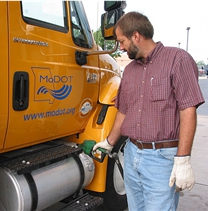
利用生物柴油產(chǎn)量的不斷提高����,設(shè)計(jì)人員正規(guī)劃新戰(zhàn)略(美國國家生物柴油委員會(huì))
在過去100年來��,內(nèi)燃機(jī)燃油一直沒有什么重大的變化���,但今后就說不一定了���。生物燃油研究不斷取得進(jìn)展,非公路商用車工程師開發(fā)的新技術(shù)使發(fā)動(dòng)機(jī)能夠使用各種不同的混合燃油���。
生物燃油方面采取的大量行動(dòng)����,但是在從替代能源躍升為主流能源的競賽中�,生物燃油卻落后于天然氣����。根據(jù)美國環(huán)保局(EPA)的消息�����,去年美國的煉油廠生產(chǎn)出大約17億加侖(約合64億升)的生物柴油�。發(fā)動(dòng)機(jī)開發(fā)商及整個(gè)供應(yīng)鏈也正努力開發(fā)新技術(shù),試圖讓所有型號(hào)的發(fā)動(dòng)機(jī)能夠使用任意調(diào)和的生物燃油���。
美國西南研究院發(fā)動(dòng)機(jī)�����、排放及車輛研究首席工程師Bapi Surampudi說道:“替代燃油的使用存在的最大問題是校準(zhǔn)��。要使成本最小化����,通常就需要在多個(gè)平臺(tái)上重復(fù)使用相同的電子設(shè)備���。因此��,難點(diǎn)之一就是要設(shè)計(jì)出一套能夠適應(yīng)各種情況的電子架構(gòu)(包括硬件和軟件)��。”
研究人員正嘗試使用不同的技術(shù)�,測試如果才能高效地檢測出可用燃油的成份。其中一個(gè)策略就是將測量燃油的傳感器放在油箱內(nèi)��,另一種方案是利用燃燒控制系統(tǒng)實(shí)時(shí)檢測向發(fā)動(dòng)機(jī)輸送的燃油。
博格華納先進(jìn)工程團(tuán)隊(duì)高級(jí)技術(shù)專家Chris Mays介紹道:“對(duì)于有自力推進(jìn)的交通工具來說����,可以通過油箱內(nèi)燃油成分檢測分析,在每次加油時(shí)進(jìn)行“重新調(diào)整”或校正����,或者也可以進(jìn)行實(shí)時(shí)檢測。這就意味著����,OEM就需要決定是監(jiān)測燃油本身還是燃燒過程�����。如果是監(jiān)測燃燒���,不管是直接還是間接測量����,我們都將獲得大量的數(shù)據(jù)反饋,獲得發(fā)動(dòng)機(jī)組件����、系統(tǒng)及燃油變量��。”
計(jì)算機(jī)能力的迅猛發(fā)展也將幫助工程師和程序規(guī)劃師能夠高效地對(duì)燃油進(jìn)行分析��。
里卡多(Ricardo)混合動(dòng)力及電氣系統(tǒng)營業(yè)部總監(jiān)Ali Maleki說道:“電子控制裝置的性能越來越好����,燃燒過程的控制也就越來越精確,替代燃油發(fā)動(dòng)機(jī)的故障率也就相應(yīng)的減少�。新的電子技術(shù)可以更好的控制排放、廢氣再循環(huán)并精確供油����。在固定設(shè)備、火車和貨車等對(duì)運(yùn)營成本較敏感的領(lǐng)域���,使用替代燃油將是一個(gè)非常重要的趨勢��。”
隨著控制系統(tǒng)的發(fā)展�,越來越多的生物燃油都開始投入生產(chǎn),工程師將公不斷致力于讓每一滴燃油都發(fā)揮最大作用�����。
Surampudi說:“發(fā)動(dòng)機(jī)制造商必須掌握各種生物燃油的優(yōu)勢與缺點(diǎn)�,同時(shí)在更快�����、更復(fù)雜的測試中不斷積累經(jīng)驗(yàn)����。”
我們對(duì)生物燃料的了解����,很大一部分認(rèn)知是來源于建模與仿真����。燃燒過程是很復(fù)雜的,細(xì)微的變化就會(huì)產(chǎn)生巨大的不同����,所以必須要用大量的測試來提高效率�。
Mays說道:“傳感器的信號(hào)是最需要考慮的問題�����,設(shè)計(jì)階段模擬感應(yīng)器反饋有助于得到良好的信噪反饋�。比如在這個(gè)過程可以分析傳感器可以在液流中的狀態(tài)��,確保感應(yīng)器探測到各種氣體混合狀態(tài)��,濃度是否足以進(jìn)行冷凝等信息���。”
作者:Terry Costlow
Designers are devising new strategies to utilize the growing output of biodiesel. (National Biodiesel Board)
Fuel for combustion engines has not transformed significantly over the past 100 years, but things may change. Biofuel research continues to advance as off-highway engineers develop new techniques that will let engines run on varying mixtures.
There’s plenty of activity in biofuels, though they trail natural gas in the race to make the leap from alternative energy source to mainstream fuel. U.S. refiners produced around 1.7 billion gallons (6.4 billion L) of biodiesel fuel last year, according to the U.S. EPA. Engine developers throughout the supply chain are working on techniques that let operators run with any mix of fuels on any engine model.
“The adoption of alternative fuels is a calibration issue,” said Bapi Surampudi, Principal Engineer for Engine, Emissions, and Vehicle Research at theSouthwest Research Institute. “To minimize cost, the goal has always been to re-use the same electronics in multiple platforms. Therefore, one challenge is to design a common electronic architecture (hardware and software) that works in all cases.”
Researchers are exploring different techniques to efficiently determine the makeup of fuel being used. One strategy is to add sensors that measure fuel in the tank, while another leverages combustion control systems to monitor fuel as it’s fed to the engine.
“For self-propelled vehicles, the detection could be a tank-based analysis and a ‘retune’ or correction method every time the tank is filled,” said Chris Mays, Senior Technical Specialist at BorgWarner’s Advance Engineering Group. “The sensing method could also be continuous. In this case, OEMs need to determine whether to measure the fuel or the combustion. Measuring the combustion, either directly or indirectly, provides the greatest payback as it accounts for engine component and system variation as well as fuel variation.”
The rapid advance in computing power is helping engineer and programmers analyze fuels efficiently.
“Higher performance electronic control units enable a more precise control of the combustion process and reduced penalty efficiency of the alternative fuel engine,” said Ali Maleki, Business Unit Director for Hybrid and Electrical Systems, Ricardo. “New electronic technologies are embedded for better emissions control, gas recirculation control, precise fuel delivery. There is significant trend for alternative fuels in the stationary, railway, and truck applications that are more operating-cost sensitive.”
As control systems evolve and more biofuels move into production, engineers are continuously striving to eke more work from every drop of fuel.
“Engine manufacturers must become knowledgeable of the potential and the drawbacks of different biofuels and gain experience through faster and more sophisticated testing,” Surampudi said.
Much of that knowledge will be gained through modeling and simulation. Combustion is very complex, with major differences arising from minor changes, so many tests must be run to improve efficiency.
“Getting good signals at the sensors is one aspect to consider,” Mays said. “Simulating sensor responses in the design phase can help give good signal-to-noise response. This can include analysis of sensors in the gas flow stream to make sure they are sensing well-mixed gases and are robust to condensate, for example.”
Author: Terry Costlow