目前���,歐洲研究團體正在開展一項新的研發(fā)項目,旨在為下一代汽車高級駕駛員輔助系統(tǒng)(ADAS)提供高性能���、低功耗的嵌入式圖像處理應(yīng)用。
該項目代號是TULIPP (Towards UbiquitousLow-power Image Processing Platforms/面向無處不在的低功耗圖像處理平臺) 簡單來說���,該項目的目標(biāo)是在2018年前����,為設(shè)計師提供一個參考開發(fā)平臺�����,協(xié)助他們進行基于視覺的系統(tǒng)設(shè)計��。該平臺將結(jié)合功效等多種軟����、硬件參數(shù)的定義規(guī)則���,降低系統(tǒng)開發(fā)的時間和成本。
未來��,該指南可用于低功耗可擴展面板的開發(fā)��,從而滿足嵌入式系統(tǒng)對尺寸���、重量及功率(SWaP)、低功耗操作系統(tǒng)�、圖像處理庫及能量感知工具鏈的典型需求。該項目的目標(biāo)之一在于,協(xié)助軟件設(shè)計師更加輕松地應(yīng)對多核設(shè)備帶來的并行編程問題��,以及不同編程模型和應(yīng)用程序界面(API)間存在的異構(gòu)性�。
此外��,TULIPP項目還將開發(fā)三個演示用例���,進行項目的概念驗證和參考平臺驗證。據(jù)了解�,演示用例將覆蓋汽車��、航空航天和醫(yī)療等多個領(lǐng)域出現(xiàn)的各種復(fù)雜圖像處理需求����,其中一個用例中的車輛ADAS“智能”嵌入式視覺系統(tǒng)除了可以進行低級別的圖像處理外,還可以智能解讀圖像內(nèi)容��,從而為駕駛員提供更安全的駕駛體驗���。
“圖像處理技術(shù)的應(yīng)用日益廣泛,橫跨多個行業(yè)�,且復(fù)雜程度遠(yuǎn)超以往任何時候。”法國泰雷茲(Thales)集團高管���、TULIPP項目協(xié)調(diào)員Philippe Millet表示,“TULIPP的參考平臺將極大地促進系統(tǒng)整合���、圖像處理創(chuàng)新及空閑電源管理方面的發(fā)展,從而在如今基于視覺的系統(tǒng)越來越復(fù)雜的情況下�����,應(yīng)對不斷出現(xiàn)的新挑戰(zhàn)���。”
到2018年項目結(jié)束時,TULIPP項目預(yù)計可以將圖像處理應(yīng)用的峰值性能耗電比提高4倍�����,平均性能耗電比提高10倍�����。在項目正式結(jié)束之后����,該平臺預(yù)計可以繼續(xù)提升圖像處理應(yīng)用的性能功耗比��,并在2023年前達到200倍的水平?��,F(xiàn)階段,TULIPP拿到了歐洲最大研究項目Horizon 2020接近400萬歐元的經(jīng)費��。據(jù)了解����,Horizon 2020項目將在2014到2020年間提供近800億歐元經(jīng)費��,以推動有價值科學(xué)創(chuàng)新技術(shù)的市場化進程�。
未來,TULIPP項目將與各標(biāo)準(zhǔn)組織緊密合作����,從整個行業(yè)的角度出發(fā),推廣該參考平臺積累的經(jīng)驗和總結(jié)的標(biāo)準(zhǔn)��。
TULIPP聯(lián)盟成員即有行業(yè)從業(yè)人士�����,也有專家學(xué)者�����。除了擔(dān)任牽頭人和協(xié)調(diào)員的法國泰雷茲外���,項目參與方還包括法國Efficient Innovation SAS、德國Fraunhofer IOSB�����、比利時Hipperos����、挪威科技大學(xué)、德國波鴻大學(xué)����、Sundance Multiprocessor Technology和Synective Labs�。
A new European research initiative to develop high-performance, energy-efficient embedded systems for image-processing applications has implications for next-generation automotive ADAS (advanced driver-assistance systems).
The TULIPP (Towards Ubiquitous Low-power Image Processing Platforms) research consortium aims to develop by 2018 a reference platform for vision-based system designers. The platform will incorporate guidelines that define various hardware and software parameters including power efficiency, with the goal of reducing development time and cost.
The guidelines will be used to develop a scalable low-power board designed to meet typical embedded-systems requirements of size, weight and power (SWaP), a low-power operating system and image processing libraries, and an energy-aware tool chain. One goal is to help software designers deal more easily with parallel programming issues presented by multicore devices, as well as the heterogeneity of different programming models and application program interfaces (APIs).
In addition, TULIPP will develop three use-case demonstrators as proof-of-concept and validation of the reference platform. The use cases will cover the emerging complex image processing requirements of various industry sectors including automotive, aerospace and medical. One use case involves a "smart" automotive embedded vision system for automotive ADAS that, in addition to the low-level image processing, will intelligently interpret what is on the images to deliver safer driving experiences.
“Image processing applications stretch across an increasingly broad range of industrial domains and are reaching a higher level of complexity than ever before,” said Philippe Millet of Thales and TULIPP project coordinator. “The TULIPP reference platform will give rise to significant advances in system integration, processing innovation and idle power management to cope with the challenges this presents in increasingly complex vision-based systems.”
When the project concludes in 2018, TULIPP expects its work to extend the peak performance-per-watt of image processing applications by 4x and average performance-per-watt by 10x. Beyond the official completion, it is expected that this will be extended to 100x and 200x by 2023. TULIPP is being funded with nearly €4 million from Horizon 2020, the EU's biggest research program. The organization has nearly €80 billion in funding available from 2014 to 2020 for bringing science and technology innovations to market.
TULIPP plans to work closely with various standards organizations to propose the formal adoption, on an industry-wide basis, of new standards derived from its reference platform.
The TULIPP consortium members represent both industry and academia. Along with project lead and coordinator Thales, the members include Efficient Innovation SAS, Fraunhofer IOSB, Hipperos, Norges Teknisk-Naturvitenskapelige Universitet, Ruhr-Universität Bochum, Sundance Multiprocessor Technology, and Synective Labs.
Author: Jennifer Shuttleworth
Source: SAE Automotive Engineering Magazine
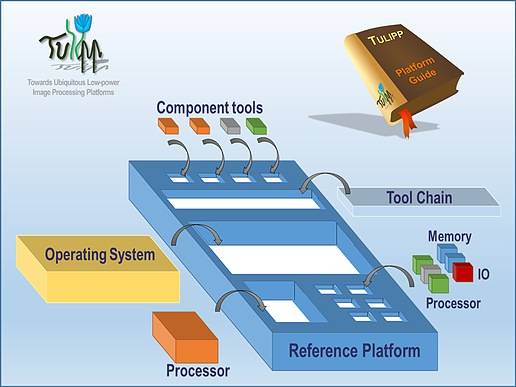 TULIPP項目參考平臺的組件架構(gòu)。
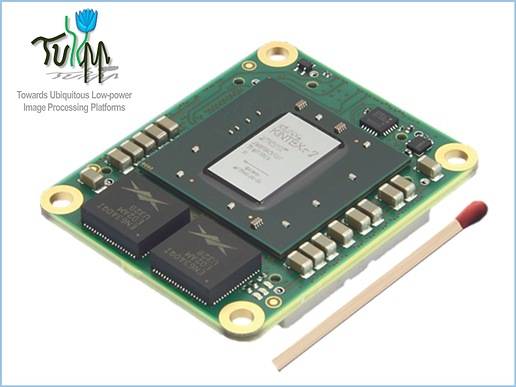 TULIPP項目參考平臺的硬件設(shè)計